


ThirtyTwo Lashed Double BOA x Volcom 2025

Thirty TWO TM-2 Double BOA Black White GUM

ThirtyTwo TM-2 Double BOA Wide 2025 Scarpone Snowboard

Thirty TWO Jones MTB BOA Scarpone Snowboard

Union Reset Pro 2026 Scarpone Snowboard

Salomon Faction BOA Scarpone Snowboard

SALOMON PEARL BOA BLACK WOMEN'S SNOWBOARD BOOTS

DC Phase Black Scarpone Snowboard

Nidecker Altai Men Dual BOA 2026 Scarpone Snowboard

Nidecker Altai Woman Dual BOA 2026 Scarpone Snowboard

Nidecker Cascade 2026 Scarpone Snowboard

Nidecker Sierra Women Single BOA 2026

Nitro Sentinel Double BOA Scarpone Snowboard

Nitro Sentinel TLS Black Snowboard Boots

Nitro Tangent TLS Black Snowboard Boots

Nitro Tangent BOA Black Snowboard Boots

Salomon Launch BOA SJ BOA 2026

Salomon Launch BOA SJ BOA 2026

Salomon Dialogue Dual BOA 2026 Scarpone Snowboard

Salomon Echo Dual BOA 2026 Scarpone Snowboard

Salomon Ivy BOA SJ BOA Donna 2026 Scarpone Snowboard

ThirtyTwo Lashed Double BOA 2025 Scarpone Snowboard

ThirtyTwo Shifty BOA 2025 Scarpone Snowboard

ThirtyTwo Shifty Boa Donna 2025 Scarpone Snowboard

ThirtyTwo TM-2 Double BOA Wide X Bode Merrill 2025
Snowboard boots: comfort and performance for every style
A snowboard boot are key parts of your gear. They are the main link between your body and the board. Comfort, control, and performance depend largely on choosing the right boot.
Choosing the right boots can change your day on the mountain. They can improve your riding, reduce fatigue, and boost your enjoyment on the snow.
The right pair of snowboard boots can completely change your control and confidence on the mountain.
In our catalog, you will find snowboard boots for men and women. We have models from the best brands, for beginners, intermediates, and experts. There are boots for park, all-mountain, and freeride. Each boot is chosen to give you the best balance of comfort, performance, and durability.
Many riders come to us after using the wrong boots. In most cases, the board is not the issue. The problem is weak heel hold or flex that does not match their skill level.

Men's and women's snowboard boots for all levels
Our selection includes men snowboard boots and women’s models built for different levels and foot shapes.
Every snowboarder has different needs. That's why snowboard boots are not all the same. Your level of experience affects your choice of flex, structure, and support.
If you are a beginner, comfort is very important. Beginner boots are softer and easier to wear. They are also more flexible, helping you improve without sore feet. Boots that are too stiff can slow your progress.
If you already have experience, a stiffer boot will give you more response and precision. This is important for fast turns and changes of direction. Intermediate and advanced snowboarders look for boots that wrap around the foot and ankle well. They also need to be comfortable, even after many hours on the snow.

Snowboard boots for park, all-mountain, and freeride
The discipline you practice affects your boot choice. If you often visit snowparks, choose boots with medium or medium-soft flex.
These boots let you move freely and absorb impact. They also feel more playful. In parks, many riders choose models with classic laces. Riders like this lacing for its direct feel and street style.
For all-mountain use, the ideal boot is versatile. It must feel responsive on groomed slopes. It must also stay comfortable during long riding days. These models are in high demand. They let you do a bit of everything. You can carve and do light park riding.
Freeride snowboarders who love fresh snow need stiffer, high-performance boots. Stability, precision, and support are key, especially on steep slopes or in changing conditions.
In these cases, quick-release closure systems such as BOA or Speed Lace make all the difference in terms of practicality and control.

Fit and comfort: the basis of everything
A snowboard boot must fit well. Your foot should feel stable. There should be no pressure points or extra movement. A boot that is too tight can hurt. It can also make your feet cold. A boot that is too loose can reduce sensitivity. It can also reduce stability on the board.
Modern inner boots shape to your foot with use. This is normal after a few outings. So, it is important to choose the right size from the start.
In our store, you will find models for different foot shapes. They are designed to offer comfort to beginners. They are also suitable for those who spend many hours in the mountains.
The right size does not simply mean “comfortable when first worn.” A new snowboard boot should fit snugly, with the heel well secured and the toes slightly touching the toe box.
After a few outings, the inner boot will compact and adapt, increasing the internal space by a few millimeters.
A simple test in the store is to simulate a forward bend: if the heel lifts visibly, the boot does not provide adequate support for technical riding or high-speed carving.
Always choose your boot based on your riding style and the terrain you ride most.

Biomechanics of the foot and posture in snowboarding
When you ride, your foot acts like a lever. Any pressure on your toe or heel moves to the board. It goes through the boot.
If the structure does not support the foot arch, ankle, and shin well, energy spreads out and the response is less precise.
A well-designed boot stabilizes the foot without locking it in place. It keeps the foot mobile, while still providing structural control. This balance allows precise edge changes and stable high-speed turns.
Knee-ankle-hip alignment
Proper alignment of the knees, ankles, and hips helps spread loads correctly while skiing. When the boot supports the leg in a balanced way, force transfer is more direct. This also reduces joint fatigue.
If the boot is too soft or too stiff for your style:
• Your knees work poorly
• Your ankle loses stability
• Fatigue increases
A good boot maintains the natural alignment of the leg, especially in aggressive turns.

Canting and natural inclination
Canting is the sideways tilt of the base or inner support. It helps the foot stay in a more natural position on the board.
Not all riders have the same knee shape. For this reason, the correct angle can help. It can compensate for possible anatomical misalignments. In advanced setups, boots, bindings, and footbeds work together. This helps optimize posture, comfort, and precise edge changes.
Some advanced boots work in synergy with:
• Canting bindings
• Inclined footbeds
• Anatomical supports
This reduces joint tension during long days on the mountain. In technical freeriding, this difference can be felt after just a few descents.

Snowboard boot lacing systems
Modern lacing systems improve fit precision and on-snow performance. Today, there are several closure systems, each with its own advantages.
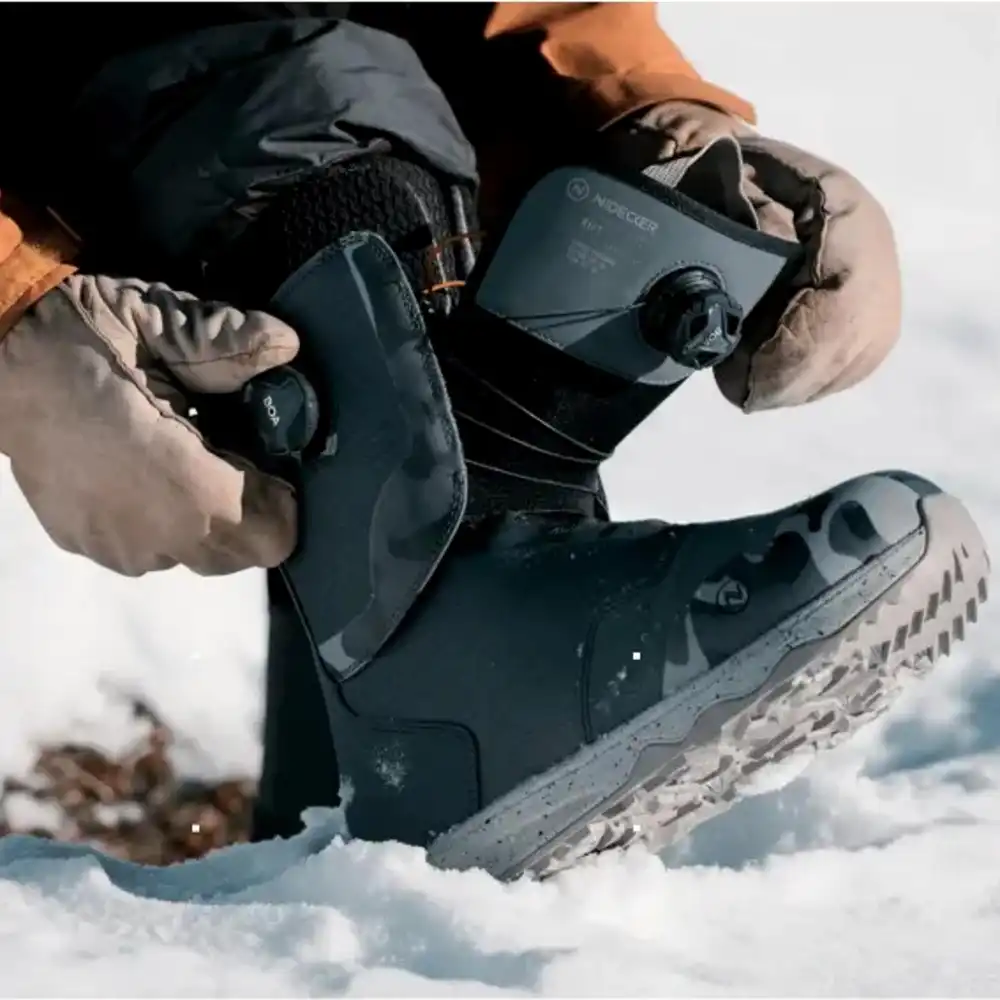
BOA snowboard boots are very popular. This is due to their quick, precise fit. With one simple move, you can tighten them evenly and securely. BOA snowboard boots use a micro-adjustable boa system for fast and precise tightening.
The Double BOA system lets you adjust the front and rear separately. This gives you great control.
The Speed Lace system is fast and reliable. It is widely used by those who want to put on and take off their boots quickly without compromising performance.
Snowboard boots with traditional laces are still very popular, especially in freestyle. They offer a traditional feel and a custom fit. Plus, they have a timeless look.
The closure is not just a matter of comfort, but directly affects precision and pressure distribution.
Snowboard boot soles: grip, durability, and real performance
The sole of snowboard boots is often overlooked, but it is key for mountain performance.
It affects walking and comfort when transferring. It also helps with stability on icy surfaces. It helps manage vibrations. It improves energy transfer between the foot, binding, and board.
It affects:
• Stability on ice
• Vibration absorption
• Power transmission
Materials used
• High-density EVA for cushioning
• Technical rubber for grip
• Shock-absorbing inserts in the heel
In freestyle, cushioning is key for landings. In freeriding, a stiff sole helps control on mixed terrain. Some brands use Vibram soles or their own high-grip compounds.

Boot flex level
The flex level of a snowboard boot defines the longitudinal and torsional stiffness of the structure. This value directly affects the speed of response in edge changes, stability at high speed, and the ability to absorb vibrations and impacts.
A flex that is too soft can cause energy dispersion; one that is too stiff, on the other hand, can limit mobility and comfort if not suited to the rider's technical level.
Flex 1–3 (Soft)
Ideal for beginners and freestyle, it offers a forgiving structure, greater ankle mobility, and impact absorption on boxes and rails; it reduces muscle fatigue, facilitates presses and butters, and makes progression more natural and less stressful in the early seasons.
Flex 4–6 (Medium)
Perfect for all-mountain and intermediate riders, it combines lateral support and comfort, ensuring good energy transmission when carving without excessive stiffness; versatile on the piste, in the park and in occasional fresh snow, it maintains a balance between control, sensitivity and durability on long days.
Flex 7–10 (Stiff)
Designed for freeriding and advanced riders, it has a reinforced structure and higher torsional rigidity for precision at speed. It improves power transfer on steep slopes and hard-packed snow. It needs solid technique, but it delivers better control and stability.
For advanced riders, a boot that is too soft can cause small delays in power transfer. This is most noticeable when you change edges at high speed. A flex that is too stiff for your skill level can tire your shin and ankle. Over time, this can reduce your control and precision.
The flex rating listed by the brand may not match how it feels when you ride. The boot may feel stiffer or softer due to temperature, rider weight, and boot design.
At low temperatures, some materials get stiffer. This boosts response but lowers tolerance. That is why it is important to assess flex based on your riding style. Also consider the conditions you usually ride in.

Internal structure of snowboard boots: materials, technology, and real support
When it comes to snowboard boots, the difference is not just looks or the closure system. The real difference is inside, in the structure that supports the foot during energy transfer.
The internal structure gives torsional stability, precise edge changes, and comfort on long days. It also helps it keep its shape over time.
A well-designed interior reduces small movements. It improves body alignment. It allows a more direct response between the foot, binding, and board. This is where true snowboard boot quality is measured.
Liner (inner boot): the heart of comfort and control
The liner, or inner boot, shapes the true feel of a snowboard boot. It touches the foot first. It stabilizes the foot, keeps it warm, and spreads pressure evenly.
In technical models, the liner is not just padding. It is an engineered structure with varied foam densities. It has targeted reinforcement zones. It uses thermoformable materials that adapt to the foot’s shape.

Heel Hold: the real secret to precision
Heel control, also called heel hold, is key when choosing a technical snowboard boot.
The heel must remain firm and well attached to the back of the boot throughout the turn. If the heel lifts even a few millimeters, energy is lost. The board's response becomes slower. Precision in edge changes is reduced.
Effective heel hold comes from pre-shaped heel pockets, firm foam inserts, and locking systems built into the liner.
In high-performance models, you will find:
• Pre-shaped anatomical pockets
• Internal side reinforcements
• Internal heel locking systems
This is especially important in carving and technical freeriding.
External structure and paneling
The outside structure of the snowboard boot affects how force moves to the board. The shell protects the foot and supports the boot.
It also affects side stability, twist stiffness, and long-term durability. Material choice, panel layout, and reinforcement zones shape how the boot reacts while riding.
The outer shell of the boot determines:
• Lateral stability
• Durability
• Response precision
The most advanced models use reinforced synthetic materials, heat-sealed panels, and less stitching to reduce failure points.

Compatibility, stack height, and Step On boots systems
An often overlooked aspect is the compatibility between the sole, binding, and attachment system. The geometry of the sole directly affects the stack height, i.e., the distance between the foot and the board.
A lower stack improves sensitivity and ground feel. It makes edge changes faster. A slightly higher stack can absorb more impact. But it reduces the direct feel of the board.
In traditional two-strap systems, the sole must provide a stable, even surface for proper pressure transfer.
In Burton Step On bindings systems or boards with dedicated mechanical bindings, compatibility is even more important.
The sole has specific anchor points that must match the binding exactly. Here, rigidity, thickness, and manufacturing precision are structural needs, not just comfort features.

Pleasures Milano snowboard shop since 1999
Pleasures Milano has been snowboarding since 1999. For over 25 years, we have selected, assembled, and tested snowboard boots in real conditions, not just in catalogs.
Each season, we review materials, flex, inner build, and fit with boards and bindings. We compare models across brands to offer a technical, consistent selection.
We don't just sell boots: we test them, adjust them, and adapt them to riders with different needs, from beginners to expert freeriders. This direct experience allows us to evaluate real heel hold, torsional response, comfort after hours of riding, and durability over time.
Choosing Pleasures Milano means relying on an independent snowboard shop with concrete experience, qualified technical advice, and in-depth product knowledge.
We have worked for years with top brands in the industry. We have chosen hundreds of boots for our customers. Our goal is to offer maximum control and reliability in every riding condition. They should not just look good on paper.


